
End of the tunnel. Finally.
For sixty years, industrial robots have been brilliant and blind. Engineers wrote every motion by hand, and a robot that welded car doors or packaging could do nothing else. Physical AI is about to change that.
Meanwhile, we are buzzing about AI. In Q3 2026 alone, AI startups raised $102 billion, 64% of all global VC funding, across a record 27 billion-dollar rounds (Crunchbase). AI has learned to read, write and code, make deep fakes, optimize social media content, automate customer service and fill your inbox with junk messages. And now, finally, it is learning to touch, lift, walk and build.
My thesis #1: The startups that win this chapter are the ones that own the hands, the data, the factory floor, laboratories, and the street.
AI leaves the screen and robots become the utility?
A year ago, in our Beyond agents post, we foresaw with Jenny Engerfelt that general-purpose models would commoditize and that durable value would move to next-generation models and domain-specific intelligence built on proprietary data. We named physical AI as one of the shifts to watch. It has arrived faster than we expected: VC investments to robotics grew 2X just in one year to $9.9 billion in Q3 2026.
Physical AI is AI that perceives the real world through sensors, reasons about it, and acts on it through a body: an arm, a gripper, a drone, a vehicle, lab equipment, a satellite. Unlike a software agent, its mistakes can break real things. That is what makes it hard, but also what makes it valuable.
The Physical AI is happening already:
- On the street. Starship Technologies‘ sidewalk robots have made more than 10 million autonomous deliveries. In Finland, they carry roughly one in five grocery deliveries.
- In the forest. Swedish AirForestry flies autonomous drones that thin forests from above, with no strip roads and no soil damage.
- On the factory floor. About 5 million industrial robots work in factories worldwide; most do one task, programmed by hand. The Human Touch Robotics shows the next era: an AI-guided gripper that can pack delicate items like raspberries, sushi and eggs without crushing them.
The turn came faster than expected. A few weeks ago, Dream Labs, founded this year by former NVIDIA robotics researchers, raised a $90 million seed round and opened an API that turns a camera feed and a plain-English instruction into motor commands, even on two-armed robots it has never seen. Price: $3 an hour.
Two far larger players, Skild AI, valued at more than $14 billion in January, and Physical Intelligence, last valued at $5.6 billion, are building one brain for every robot. Dream Labs now rents that bet out by the hour, turning it into a race for market share, just as the large language model players did.
The science: from words to physics
Under the hood, four technological advancements are turning robots from single-task machines into machines that learn.
- Vision-language-action models. Robots get the same kind of brain as chatbots, but it outputs movements instead of words. The model sees the scene through a camera, reads an instruction such as “fold the shirts”, and turns both into motor commands up to 50 times a second. Example: Physical Intelligence’s π0, trained on eight different robots, folds laundry, clears tables and assembles boxes with one model.
- Synthetic data. Language models learned from the whole internet; robots have no internet of movement to learn from. So the industry manufactures it in physics simulators, where a robot can practise far faster than in the real world. Example: NVIDIA’s GR00T N1 team generated about 6,500 hours of training demonstrations in 11 hours of simulation.
- Cross-embodiment learning. A skill learned on one robot body transfers to another, which makes a universal robot brain possible. Example: Google DeepMind and 33 academic labs pooled data from 22 robot types into the Open X-Embodiment dataset. The shared model succeeded about 50% more often than models trained for each robot alone. Skild AI’s “omni-bodied” brain is the commercial version of this bet.
- World models: the competing school. Instead of generating words or pixels, these models learn how the world behaves and predict what happens next, so robots need far less costly robot data. Example: Meta’s V-JEPA 2, built on Yann LeCun’s JEPA architecture, learned from over a million hours of video. With only 62 hours of robot data, it planned pick-and-place tasks in new environments, succeeding 65–80% of the time. LeCun’s new company AMI Labs has raised a $1.03 billion seed to pursue the idea. Closer to home, Voima portfolio company Farang (Stockholm) is building a new architecture that has up to 25 times lower compute use, which matters for robots that must think on board with limited power.
The reality: the science is still young. For example, the GR00T N1 authors themselves note that the model focuses on short, tabletop tasks and that synthetic data still struggles with physical realism:
“A model that succeeds 77% of the time in a lab is a breakthrough. On a production line, it is a recall”.
The future we see is clear in direction, if not in timing.
Thesis #2: Models will move from short tasks to long ones, from labs to messy real sites, and from imitation to learning on the job. Every deployed robot becomes a data collector. The fleet with the most real-world hours will improve fastest.
The universal brain becomes a utility
The most expensive bet in robotics is “one brain for every robot”. Capital has followed it fast:
| Player | Bet | Capital signal |
|---|---|---|
| Skild AI | One brain for any robot body | $14B+ valuation, Jan 2026 |
| Physical Intelligence | General-purpose robot models | $5.6B; talks at $11B+ |
| NVIDIA GR00T | Open model, given away to sell chips | Free |
| Dream Labs | Robot control as an API | $90M seed; $3 an hour |
| SoftBank | Bought ABB Robotics | $5.4B |
When the foundation layer gets cheap, the model stops being the moat. Cloud computing did not make the server makers rich. It made the companies that used cheap compute to solve specific problems rich.
But here is the interesting part: the world is not ready yet. Robots need fast, cheap decisions that comes with a calibrated confidence score, so a machine knows when to stop. Jev, a new model from ChatGPT builder Diogo Almeida’s TypeSafe AI, points the way. It is not a robotics model; it automates software decisions by returning a probability for each option. Its name is a hint too: economist William Stanley Jevons showed that when a resource gets cheaper, we use more of it. Cheap intelligence will put robots into thousands of tasks nobody could afford to automate before.
The gap between demo and deployment is the real business. Dream Labs itself calls Dream-1 a research beta, not yet validated for safety-critical use.
Thesis #3: Closing that gap, from “works in the lab” to “works every shift, for years”, requires what no API sells: hardware that survives, data from real operations and deep process knowledge.
Where value is created: beyond the factory
The factory is the obvious market, but not the only one. Physical AI wins first where three things meet: work that is dangerous, dull or impossible for people; scarce labour; and a physical process that can be measured. The Nordic and Baltic region is unusually rich in all three.
| Category | What physical AI does | Examples |
|---|---|---|
| Food handling and packaging | Picks soft, irregular items that classic grippers crush | The Human Touch Robotics (Voima portfolio): adaptive gripper for soft food |
| Flexible manufacturing | Robots that learn new products in hours, not weeks | 120ft (Stockholm): humanoid-run microfactories built from three 40-foot containers |
| Construction and infrastructure | Moves building from the site into robotic microfactories | Hyperion Robotics (Finland): robots 3D-print low-carbon concrete foundations; first UK site with LKAB |
| Logistics and last mile | Autonomous delivery at city scale | Starship Technologies (Estonia): 10M+ deliveries in eight countries |
| Forestry and land | Harvesting without heavy machines on fragile soil | AirForestry (Sweden): autonomous drone thinning |
| Defence and security | Autonomous detection and response to drones | Sensofusion (Finland): counter-drone software; listed on Nasdaq Helsinki in October 2026 |
| Planetary sensing | Gives machines and decision-makers senses beyond the human eye | Kuva Space (Voima portfolio): hyperspectral satellites; selected for NASA’s commercial data program |
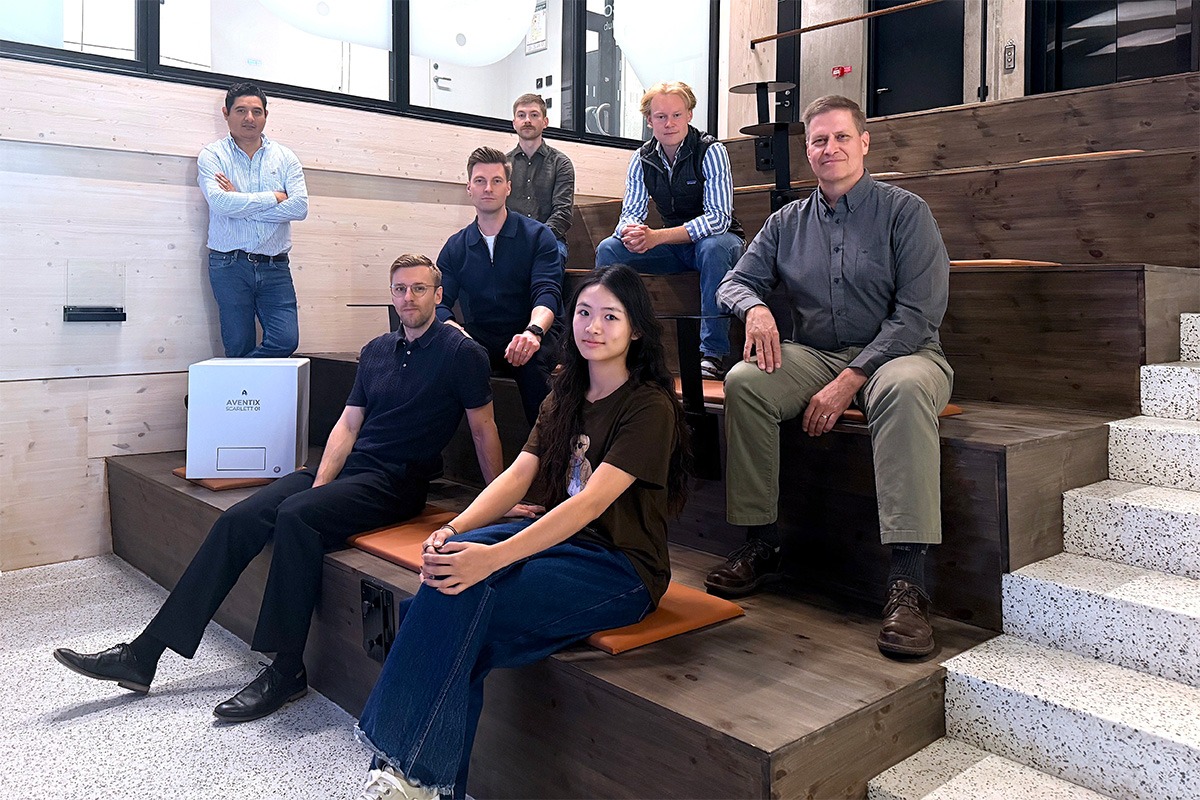
| Pharma & labs | Verifies every robotic lab step, so automated experiments produce data AI can trust | Aventix (Gothenburg, Voima portfolio): checks the liquid a lab robot dispensed into all 96 wells in about 30 seconds |
The pattern across all of them: the hard part is the last centimeter. A raspberry, a wet log, a well of liquid. No universal brain handles these reliably today, so the value sits in the hand, the sensor and the process that touches the material. That is also why Voima backs companies that give machines new senses, such as Agate Sensors’ on-chip hyperspectral sensors and Helmee’s automated surface inspection.
Where Voima invests, and why
Back to thesis 1: the brain will be rented, and everything around it will be defended. That is where we invest.
| We invest in | Why it is defensible | What we look for |
|---|---|---|
| The hands: grippers, actuators, tactile sensing, end-effectors | Physics does not commoditize. Every material behaves differently, and IP sits in hardware and know-how | Proven performance on a hard material; a path to unit economics |
| The senses: new sensor modalities and perception | Better perception lifts every model built on top of it | Deep science, often from VTT or Nordic universities, with a clear industrial buyer |
| The data: vertical deployments that collect proprietary operational data | Real-world hours compound. Each robot in the field trains the next | Paying deployments, not pilots; data rights in customer contracts |
| The process: robotics built for one hard industry, such as food, construction, forestry, mining or energy | Domain knowledge is the hardest thing for a generalist to copy | Founders who know the process as well as the technology |
| The trust layer: safety, validation and reliability | The gap between a beta and safety-critical use is the whole business | Certification paths, uptime data, insurer and regulator acceptance |
What we are cautious about is just as important. We don’t plan to compete with billion-dollar labs on general-purpose robot brains. And we are wary of companies whose only edge is a model that the next API release could match.
Industrial partners: our unfair advantage
In software, a startup can reach a million users from a laptop. In physical AI, it needs a forest, a mine, a port, or a production line. That is where the Nordics and Baltics can outplay Silicon Valley. Our region is home to global leaders in forest machinery, cranes, mining equipment, elevators, marine and energy systems. They own exactly what startups lack: real sites, real data and decades of process knowledge. Our engineering schools and research institutes, such as VTT, where Voima’s first fund began, supply the founders. And our expensive labour forces automation earlier than elsewhere.
The model already works. Holmen, SCA, Stora Enso and Sveaskog put SEK 20 million into a joint AirForestry pilot on their own land. Hyperion is building its first UK microfactory with LKAB. And Odense grew a whole robotics cluster around Universal Robots.
What we ask of industrial partners:
- Open your sites as testbeds – and make it quick, speed is the asset.
- Share data on fair terms – and make it quick, API based.
- Buy early, and buy for real – the industrial flywheel requires customer deployments
- Co-invest or partner on distribution – like the big software or Nvidia does. Win. Win. Win.
The companies that do this now will shape the robots their industries run on. The ones that wait will rent them.
What’s next: five predictions
- The price war in robot brains is a war for data. NVIDIA gives its models away, and Dream Labs rents one for $3 an hour. Both want to be on as many robots as possible, because every robot in the field sends training data back. Data rights will become a standard line in every robotics contract. Expect most foundation-model startups to be acquired or squeezed out within two to three years.
- Vertical expertise becomes the scarcest asset. A general brain knows how to grasp. It does not know how a wet log behaves in a harvester head, how fresh concrete cures, or which dispensing error ruins a drug assay. That knowledge lives with people who have run the process for years. Winning teams will pair robotics engineers with domain experts from day one, as The Human Touch Robotics does in food, Hyperion in concrete, AirForestry in forestry, and Aventix in the lab. Expect industrial incumbents to buy this expertise rather than build it.
- Safety and verification become the moat. As robots share space with people, “works in the demo” will no longer sell. Europe’s Machinery Regulation, applying from January 2027, explicitly covers autonomous mobile machines and AI-based safety functions. Companies that can certify reliability will turn Europe’s regulatory depth into an export advantage.
- Microfactories go mainstream. Robots that learn new tasks in hours make small, local production viable. Reshoring will be led by compact, robot-run units near customers, like those of 120ft and Hyperion, not giant plants far away.
- Physical AI reaches public markets. Sensofusion’s listing in Helsinki is an early sign. Investors who missed the AI software wave will look for AI that moves atoms, and will pay a premium for real deployments and vertical revenue, not demos.
The first chapter of AI was about language. The next one is about the physical world, and that is where Europe’s industrial strength finally becomes an AI advantage. The question is not whether robots will get smart. It is who will own the hands, the data, the know-how, and the floor when they do.
Inka Mero, Managing Partner, Voima Ventures