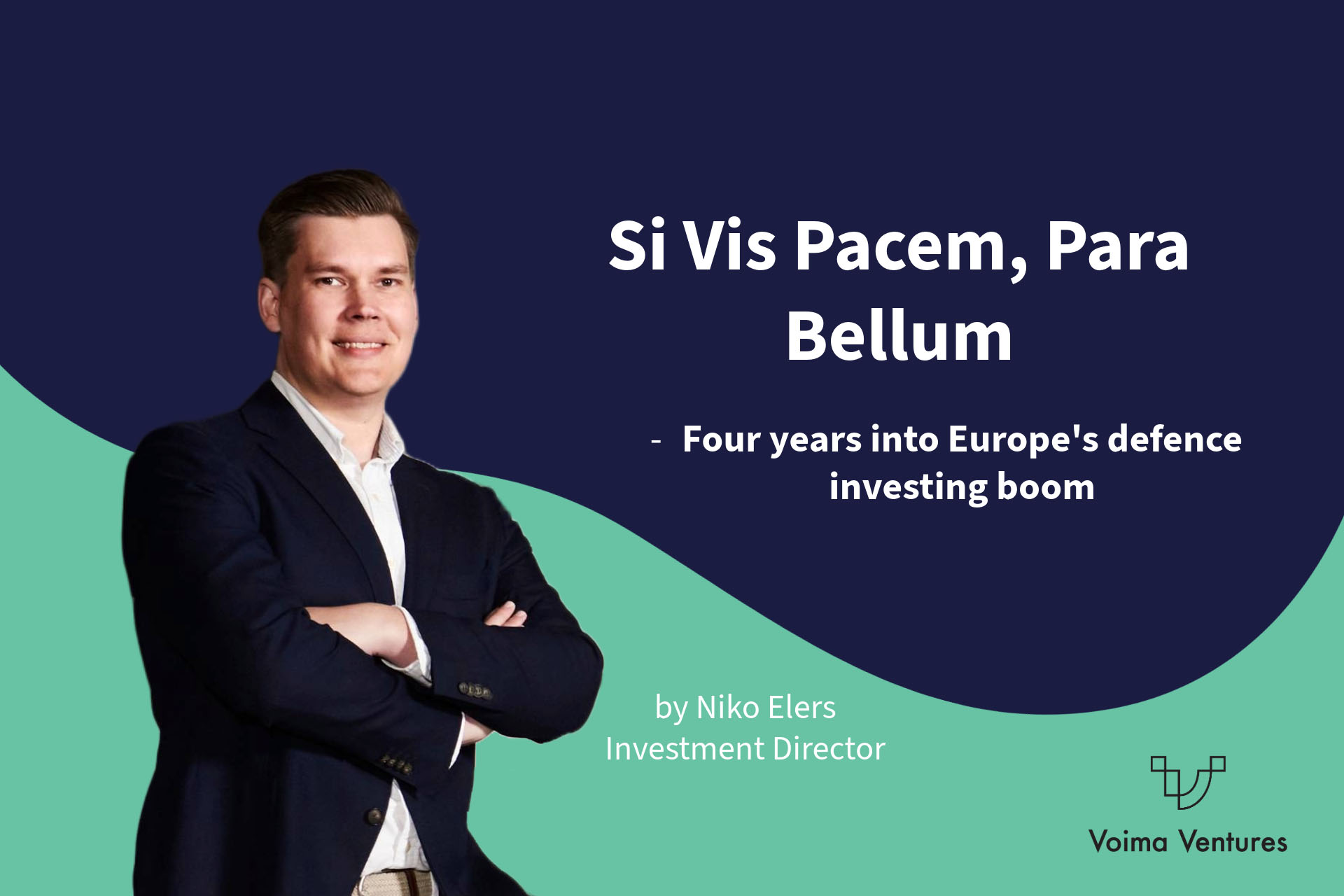
Four years into Europe’s defence investing boom, a few patterns are becoming visible.
“If you want peace, prepare for war.” Roman writer Vegetius wrote it in the fourth century, and it has served as a foundational principle of European statecraft for sixteen hundred years until the fall of the Soviet Union. Since 2022, it has also become a thesis for venture investing.
Between 2022 and 2025, European defence investing went from less than 1% of all capital to 13% of the total. Helsing reached €12 billion, ICEYE proved a Nordic dual-use unicorn was possible, and the European Commission unlocked €1.5 billion in EDIP grants alongside a €150 billion SAFE loan facility. The NATO Innovation Fund participated in roughly a third of European defence rounds during this period, and venture capital, including funds that had never written a defence check, committed at a scale that would have been unthinkable just a few years earlier.
Last year, 8.7 billion EUR flowed into European defence, security and resilience startups, up 55% year-on-year, but strip out the mega-rounds and underlying growth runs closer to 25-30%. M&A is up 4x from four years ago, though mostly tuck-ins at modest multiples. The Stockholm and Helsinki exchanges did not list a single defence company in 2025, besides the merger of Summa Defence. Capital has moved faster than exits, which is not unusual for a new category, but does mean that most of the thesis remains unproven. The next few years will reveal a great deal about which allocations were well-priced.
What the data is showing
A few patterns stand out when you look at how capital has actually been deployed in European defence since 2022.
The first is that “defence” and “dual-use” at least used to be treated as a single category when they are structurally distinct. Pure-defence companies face a set of constraints that are difficult to reconcile with venture economics: a single sovereign buyer, fixed-price requirement contracts, export controls that limit market reach, primes that acquire slowly and at modest multiples, and a cleared-engineer talent pool that grows in years rather than quarters. Dual-use companies that successfully cross into civilian markets face none of these in the long run. Both categories still need DPI (real financial returns) before the consensus they already enjoy is fully earned.
The second observation is about scope. From where we sit, defence looks less like a megatrend in its own right and more like a time-bound opportunity nested inside a broader deep tech megatrend. For most companies in this space, a defence customer matures the technology toward commercial markets that are seldom venture-scale in themselves. GPS was a defence program before it became consumer mobility. Sensor fusion was a battlefield problem before it became autonomous driving. We believe the pattern keeps repeating.
The wedge
This is where the dual-use wedge thesis comes in, and where we at Voima Ventures have chosen to focus.
A defence ministry experimentation contract worth €3-5 million pays for technical risk reduction that no civilian customer would fund pre-product. The same risk reduction would otherwise require €3-5 million of equity in a Series A round. In effect, the contract substitutes for dilutive equity while validating technology in real production environments rather than slide decks. The arbitrage is real, but it closes past Series B or C, when defence revenue begins to shape the company more than the company shapes its technology.
Two of our portfolio companies illustrate what this looks like in practice. Kuva Space, a Finnish hyperspectral satellite operator founded out of Aalto in 2016 as Reaktor Space Lab, runs a constellation strategy backed by interest from national defence agencies, ESA Civil Security funding, and interest from US agencies. But the truly huge scale market in the 10+ year timeline might not be defence; it is methane detection, agricultural analytics, and climate intelligence etc.
AGATE Sensors is younger. The team came out of Aalto with a hyperspectral imaging on a chip. We co-led the seed in 2025 with LIFTT from Italy, and by the end of that year, the company had its first defence contract, funding application maturation that no civilian electronics OEM would have funded pre-product. The civilian outcome will be sensors inside smartphones, wearables, and medical devices.
What follows from this
The constraint, in our experience, is founder selection. Founders who can navigate experimentation-tier procurement are a distinct subset of the European pool. Most of the ones we have backed have reservist or conscription backgrounds, which is not coincidental: they understand the customer because they have been the customer, or at least can put the capability into context. The Nordics and Baltics appear structurally advantaged here. Defence ministries in this region actually return calls, the total-defence doctrine creates dual-use civilian demand naturally, and the university spinout pipeline through Aalto, KTH, Chalmers, LiU, and the Baltic technical universities is unusually productive for the size of the population.
It is worth noting that the window itself is time-bound. European Defence Industry Programme funding, post-Ukraine procurement officers willing to engage with startups, and primes that have not yet built systematic acquisition pipelines all sustain the wedge, and all are subject to reversal.
Si vis pacem
Something worth acknowledging: as someone who also serves as our fund’s ESG Director, I am acutely aware that defence investing and responsible investing have historically been placed at opposite ends of the spectrum. Many institutional investors built their ESG frameworks around exclusion lists, and defence sat comfortably on most of them. That framing made sense in a different era. It makes considerably less sense in one where the democratic institutions that underpin every other ESG objective, from climate action to labour standards to transparent governance, require active defence & deterrence.
The LP landscape is already reflecting this. Across Europe, pension funds, sovereign wealth funds, and institutional allocators that maintained blanket defence exclusions are revisiting those policies, not because defence became fashionable but because excluding it began to look like a failure of fiduciary duty in a world where security is a precondition for everything else an LP’s portfolio is trying to achieve. The EIF’s expanded mandate, the Nordic pension funds’ revised frameworks, and the growing conversation inside ILPA about dual-use all point in the same direction. Capital allocation is catching up with the geopolitical reality, which is, overall, a most welcome change.
Vegetius did not write si vis pacem, para bellum during a golden age. He wrote it in the late fourth century in a Roman Empire whose military readiness had already eroded, hoping to remind the institutional elite that the civilisation they took for granted required something to defend it. The Western Roman Empire fell within a hundred years of his writing, and Rome was sacked by the Visigoths mere years after. The phrase endured because the warning was correct.